Split-Bus Panels Explained
Updated 2026-10-30
A split-bus panel is an older electrical panel with no single breaker that shuts off the whole house. Instead, the top section holds up to six breakers labeled “Main,” and one of them feeds the lower section, which holds the 120-volt lighting and appliance circuits, according to home inspector Reuben Saltzman. To cut all power, every main has to be switched off. New split-bus installations stopped being allowed in 1981, but existing ones could stay, and Saltzman writes that “there’s nothing unsafe about a split-bus panel” by itself. What matters is how many mains your panel has, its condition, and whether it can carry what you plan to add, so have a licensed electrician evaluate it.
What is a split-bus panel?
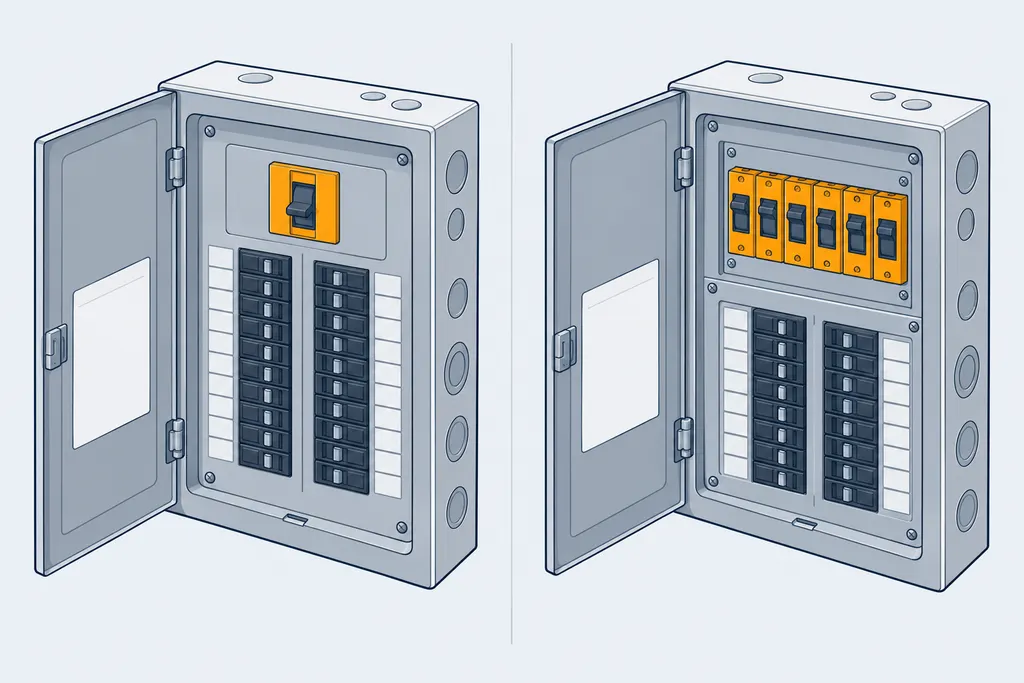
In Saltzman’s description, power enters at the top of the panel, where the breakers are the mains. One breaker in that upper section supplies the bottom half of the panel, which holds the 120-volt lighting and appliance circuits. Saltzman notes that switching off the breaker that feeds the lower section “turned off most of the power to the house. But not all of it.”
The “bus” is the set of metal bars the breakers connect to; in a split-bus panel it’s divided into an upper and a lower part.
History. Citing the book Electrical Inspection of Existing Dwellings, Saltzman says split-bus panels were allowed starting in 1965, that the mains were supposed to be 240-volt two-pole breakers with an exception in 1978, and that beginning in 1981 new installations were no longer allowed. Existing panels could remain.
How it differs from a panel with a main breaker
| Panel with a main breaker | Split-bus panel | |
|---|---|---|
| Shutting off all power | One main breaker | Every breaker labeled “Main,” up to six |
| 120-volt lighting and appliance circuits | Fed from the main | Fed through one of the mains in the upper section |
What size is the service? For a split-bus panel, Saltzman says you generally go with the service amperage listed on the panel.
The six-handle rule in plain words
The National Electrical Code (NEC) limits how many service disconnects (the switches that cut power to the whole house) a home can have. Older editions allowed up to six. InspectAPedia calls this the “rule of six” and quotes the older code wording: “not more than six switches or sets of circuit breakers.” That older rule of six is why a split-bus panel can have up to six mains.
The 2020 edition changed the rule. As Mike Holt explains it in EC&M, each service must now have only one disconnecting means except as permitted in Section 230.71(B). That section still allows two to six service disconnects for each service, but in separate enclosures, panelboards or sections, each with its own main disconnect, rather than six mains in one enclosure. EC&M notes that the previous six-main rule for a single enclosure made it impossible to work in the service equipment without the utility disconnecting power.
InspectAPedia’s editor writes that “we and others believe” the six-switch limit came from fire-fighting departments, so no more than six manual operations would be needed to turn off power in an emergency; the page presents that as belief, not documented history.
Local codes can differ. InspectAPedia notes that local jurisdictions may require a single main switch, so the electrician and your local building department have the final word.
Concerns to raise with an electrician
Saltzman, writing as a home inspector, says split-bus panels “just need to be understood.” The questions below come from how the panel works, not from a known defect:
- How many mains? These panels were installed under older code editions, which allowed no more than six mains. Ask whether your panel’s mains, including any breakers added to the upper section later, are within that limit.
- Shutting off power. Turning off the whole house takes more than one main. Ask the electrician to label every main so anyone in the house can find them.
- Condition and brand. A split-bus layout can come with a brand that has its own record. See Pushmatic Panels, Zinsco Panels and Federal Pacific Panels.
- New loads. If you plan to add an EV charger, a heat pump or other big loads, ask whether the panel and service can carry them; see Do I Need 200 Amp Service?
If the panel feels warm or buzzes, have a licensed electrician look at it soon. If you smell burning, see smoke, or the panel is hot to the touch, leave the area and call 911.
When an electrician may recommend replacement
We found no source that says split-bus panels must be replaced because of the design alone. Reasons to discuss replacement are the ones the electrician finds in your panel: damage or heat, a brand with a known record, more mains than the code allowed, or loads the panel can’t carry. Insurers set their own rules, so ask your insurer whether a split-bus panel affects your coverage.
If replacement makes sense, two cost guides give these ranges:
| Panel size | This Old House (2026) | Fixr (2025) |
|---|---|---|
| 100 amp | $800–$1,500 | $1,000–$1,600 |
| 200 amp | $1,300–$3,000 | $1,600–$4,000 |
This Old House prices a panel plus installation; Fixr’s figures are replacements with labor. A permit adds $50–$300 (This Old House), and an initial evaluation by an electrician costs $125–$250 (Fixr). See Electrical Panel Replacement Cost.
This site doesn’t give instructions for electrical work. Don’t remove the panel cover or try to rearrange breakers; that’s a job for a licensed electrician, with a permit. Our Panel Risk Check helps you see how urgent a visit is and what to ask.
Illustrations on this page are AI-generated to help you picture the situation. They are not photos of real homes, jobs or people.
Sources
- Structure Tech Home Inspections (Reuben Saltzman) — Inspecting split-bus panels (Aug 27, 2019; page modified Apr 20, 2021)
- EC&M (Mike Holt) — Stumped by the Code? Number of Service Disconnects Allowed on a Service (Jan 13, 2021)
- InspectAPedia (Daniel Friedman) — Main Electrical Panel Disconnect Switch Installation, Defects, Inspection (seminar text updated Mar 2019; reader Q&A to Nov 2020)
- This Old House — What Is the Cost to Upgrade an Electrical Panel? (updated Mar 31, 2026)
- Fixr — Electrical Panel Upgrade Cost (updated Jan 31, 2025)