Why Does My Breaker Keep Tripping?
Updated 2026-10-30
A breaker that keeps tripping is doing its job: cutting power because something on that circuit is wrong. In its 1983 safety advice for consumers, the U.S. Consumer Product Safety Commission (CPSC) says a trip is often a warning that the circuit is overloaded, and lists too many appliances plugged in, a malfunctioning product and a short circuit as causes to check. This Old House adds ground faults to that list. The CPSC’s advice is to find out why the breaker trips instead of simply resetting it — and when in doubt, to consult a licensed electrician.
The main causes and how they differ
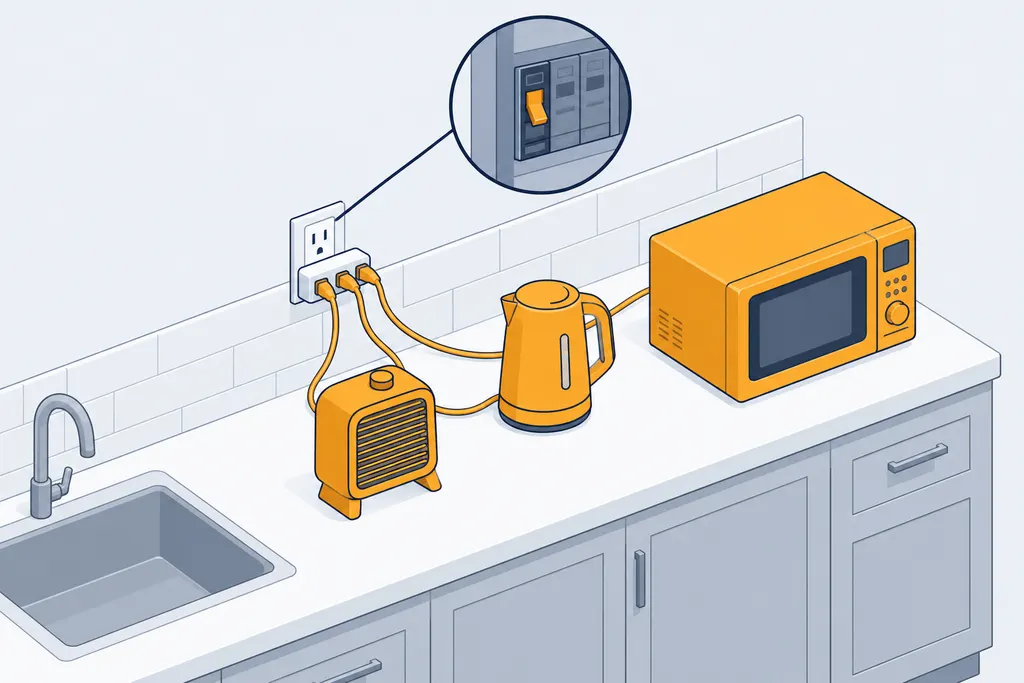
Overload. Too many devices on one circuit pull more current than its wiring is meant to carry, which This Old House notes is a fire risk. ESFI’s rule of thumb: keep a 15-amp circuit under 1,500 watts and a 20-amp circuit under 2,000 watts. A few of ESFI’s examples show how fast that adds up: hair dryer 1,600 W, portable heater 1,500 W, deep fryer 1,500 W, iron 1,000 W. The same 1983 CPSC advice warns in particular against running several high-current products, such as heating appliances, on a low-amperage circuit.
Short circuit. This Old House says a short can happen when a wire is accidentally cut, and that breakers have a part that reacts to sudden spikes in current to protect against shorts.
Ground fault. The CPSC defines it as an unintended path between a power source and a grounded surface, and says it happens most often when equipment is damaged or defective. GFCI outlets and GFCI breakers are built to cut power when they sense one — if the device that tripped is a GFCI outlet, see GFCI Outlet Keeps Tripping.
A faulty appliance. The CPSC’s Guide to Home Wiring Hazards says that when one appliance repeatedly trips a breaker, that points to a defect in the appliance that could cause a fire or shock.
What the pattern can tell you
You can narrow things down by noticing what was running when the power went off. The CPSC’s wiring guide suggests keeping track of which circuits go out and which appliances are in use each time (it gives this advice for fuses that keep blowing).
| What you notice | What the sources say it can mean | What to do |
|---|---|---|
| Trips when several high-power appliances run at once | Overload (CPSC, ESFI) | Before resetting a tripped breaker, turn off or unplug appliances and lamps on that circuit (ESFI); move a heavy load to a less-used circuit |
| Trips whenever one particular appliance is used | Defect in that appliance (CPSC) | Stop using it; have it examined by a qualified repair person (CPSC) |
| Trips when a particular switch, light or outlet is used | A wiring problem; the CPSC says to call a qualified electrician | Get a qualified electrician; don’t put in a higher-amp breaker (CPSC) |
| Breaker won’t reset after tripping | The breaker itself may need replacing (This Old House) | Have a licensed electrician look at it |
A tripped breaker isn’t always easy to spot: ESFI notes that some stop in a middle position close to ON instead of going all the way to OFF.
Warning signs that need attention
If the panel feels warm or buzzes, have a licensed electrician look at it soon. If you smell burning, see smoke, or the panel is hot to the touch, leave the area and call 911.
Repeated trips are a reason to have the house checked, especially together with any of these other signs, which ESFI, the CPSC and This Old House list. For these, have a licensed electrician look soon:
- buzzing, crackling or sizzling from outlets, switches or the panel;
- outlet or switch cover plates that are discolored;
- scorch marks on a breaker, or a breaker that feels spongy when you switch it;
- lights that flicker or dim often.
Don’t remove the panel cover or try to test the breakers yourself. This site doesn’t give instructions for electrical work; finding and fixing a fault in wiring or a panel is a job for a licensed electrician.
When the panel or breaker itself is the problem
Breakers don’t come with an agreed expiration date, according to an electrician quoted by This Old House, but one that won’t reset after tripping should be replaced by a licensed electrician. Scorch marks and a spongy feel are signs of damage.
The opposite problem matters too: a breaker that may not trip when it should. In 1983 the CPSC said its testing confirmed that Federal Pacific Electric (FPE) breakers failed certain UL calibration tests, and it closed its investigation without making a determination about their safety — see Federal Pacific Panels: Are They Dangerous?. In 1988, Challenger Electrical Equipment Corp. announced through the CPSC a replacement program for about 9,000 of its GFCI breakers, types HAGF-15 and HAGF-20, made between February 22 and April 29, 1988; the CPSC said a part could come loose and stop the ground-fault feature from working, while normal breaker functions were not affected. See Challenger Panels and Recalled Breakers.
If trips started after you added big loads, the house may need more capacity than one circuit — or the whole service — can give. ESFI says that when total demand exceeds the service to your home, an upgrade to a higher level of service is an option to discuss. See Do I Need 200 Amp Service? Our Panel Risk Check also asks about frequent trips and other warning signs.
What an electrician checks and possible fixes
ESFI recommends that a home electrical inspection cover, at a minimum:
- whether the electrical service is big enough, with a load test;
- the panel and the condition of all its connections;
- the wiring of outlets, switches and light fixtures;
- polarity and grounding at the outlets;
- required GFCIs, each one tested;
- whether the wiring is aluminum or copper, the proper size of the wires, and that they have overcurrent protection (a breaker or fuse).
ESFI says a basic inspection could take 30 minutes to an hour, depending on the size of the home. Electricians charge $40–$120 per hour, according to Fixr (more on hourly rates).
The fix depends on the cause. For an overload, ESFI mentions moving appliances to a less-loaded circuit or adding another circuit; This Old House, citing contractor estimates from Angi, puts adding a circuit at $570–$1,000 per circuit. A defective appliance needs repair or replacement. A wiring fault or a failing breaker is repaired by the electrician. If the panel needs replacing, see Electrical Panel Replacement Cost.
FAQ
Is it dangerous if a breaker keeps tripping? The trip itself is protection working. Repeated trips mean something on the circuit needs attention — the CPSC’s 1983 advice is to find the cause rather than keep resetting.
Can I just put in a bigger breaker? No. The CPSC specifically warns against putting in a higher-amp breaker when one keeps tripping.
Do I need an electrician or an appliance repair person? If the trips happen whenever one particular appliance runs, the CPSC points to the appliance and a qualified repair person. If they follow a switch, light or outlet, or have no clear pattern, call a licensed electrician.
Illustrations on this page are AI-generated to help you picture the situation. They are not photos of real homes, jobs or people.
Sources
- U.S. CPSC — Commission Closes Investigation of FPE Circuit Breakers and Provides Safety Information for Consumers (1983, revised 2011)
- U.S. CPSC — Guide to Home Wiring Hazards, Publication 518 (undated)
- U.S. CPSC — Challenger Electrical Equipment Corp. replacement program for 9,000 GFCI circuit breakers (1988)
- U.S. CPSC — What Is a GFCI? Fact Sheet, Publication 099 (Sept 2010)
- Electrical Safety Foundation International (ESFI) — Indoor Electrical Safety Check (2004)
- This Old House — How Fuses and Circuit Breakers Work (updated May 26, 2026)
- Fixr — Electrical Panel Upgrade Cost (updated Jan 31, 2025)